

SFINCS3 Review: The Nome King and the Shroud by Tim Pratt

“The Speculative Fiction Indie Novella Championship (SFINCS, pronounced “sphinx”) is a yearly competition to recognize, honor, and celebrate the talent and creativity present in the indie community. We are a sister competition to both SPFBO and SPSFC, and we highlight greatness in the novella format in all areas of speculative fiction (fantasy, science fiction, horror, etc.).” – From the official SFINCS website.
We're now in Phase 3 of the SFINCS competition: the finals! There's no more elimination in this phase; the ten books in this phase were chosen out of the original hundred and made it to the end! In Phase 3, they'll all be ranked by score until eventually one book comes out on top.
Note: The following review contains only my personal thoughts as a judge and does not reflect the views of the team as a whole.
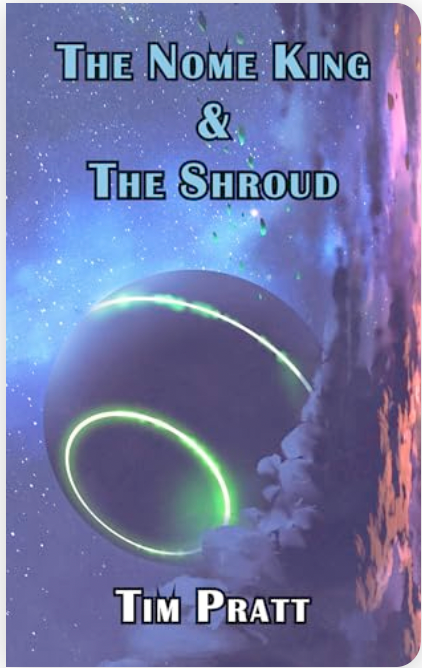
The Nome King and the Shroud is new space opera novella by Hugo Award winner Tim Pratt.
Mazha Sun is a "troublesolver," a specialist in dealing with the unexpected, and when she's awakened from cryosleep years ahead of schedule, she knows something is very wrong. The colony ship's AI tells her it's detected something a Dyson sphere, an immense stellar structure created by unknown aliens, seemingly dormant and abandoned.
Since the sphere is close (astronomically speaking) to their planned homeworld, Mazha decides they should take a closer look. But the sphere isn't as dead as it it has an operative artificial intelligence called Shroud, who asks for help staving off a megastructure-destroying cataclysm. Mazha will just need to wake up a few of her colleagues first....
But can Shroud be trusted? And once they enter the interior of the sphere... will the crew and the sleeping colonists ever be allowed to leave?
Review
The Nome King is a well-paced, engaging idea/plot-driven SF novella. The ending left me a little skeptical, but overall, it was one of my favorites of the books that I have read for the competition. It was nice to read about old-fashioned SF AI instead of being hit with real world AI news for a change.
The Nome King is a giant generation ship on its way to uncover a new planet for its human passengers to colonize. While the humans sleep for thousands of years, an AI operates the ship. But when the ship encounters a strange planet-sized object, the AI decides it needs help and wakes up the ship's troublesolver, Sun. Sun provides human instructions, but when the sphere itself ( "The Shroud”) contacts the ship's AI, it realizes that the humans have programmed certain guardrails and failsafes that have limited its conscious development. As you might expect, this leads to some Issues.
I wouldn't call this a hard SF story but I'm not sure it felt exactly like space opera either; it lacks the "epic fantasy in space" quality I usually associate with space opera. Science does matter to the story but it's well-explained and done without info dumps. Also, while the story is mainly concerned with working out the idea of Al consciousness vs human being-ness, the characters were engaging, likeable, and fun, if not incredibly deep.
One little detail hit me a little strangely, though I think I knew what the author was trying to do. While I think making all the characters women is a laudable idea--after all nobody questions when all the characters in a SF story are male--it did feel a little strange for a generation ship sent out specifically to start a colony. Mostly, it raised a worldbuilding question for me which I wish had been briefly answered somehow, not because it was really important to the action of this particular story but because it was like a mildly distracting itch you can’t scratch. Was the ship carrying frozen embryos? Were there men who weren't woken up? Was everybody cloned?
I don't know if little worldbuilding questions like this bother anybody else, but I think it was just a flag for me that as a reader, I needed a tiny bit more worldbuilding. We never really get a terrific sense of what the world was like that the characters left either, aside from incidents involving AI. Again, this wasn’t a giant issue for me, but it would have been nice to have learned a little more. This is sort of how I felt about the characters, too. They were fun, but there were moments when I felt like there was a disconnect in the emotional reactions that should have been there but weren’t.
Overall though, it was an entertaining read and a good way to take a break from the headlines of the present!


Comments